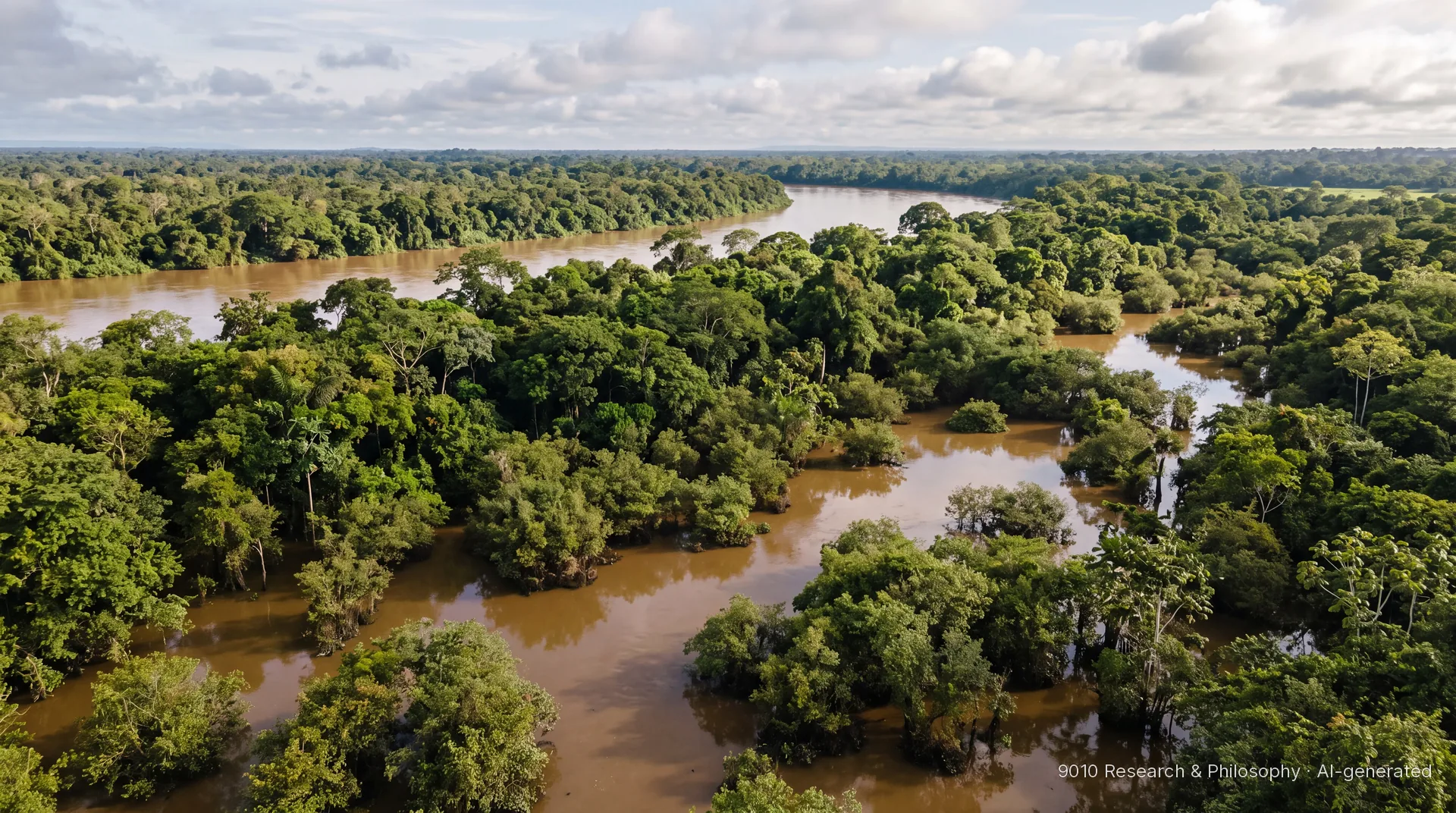
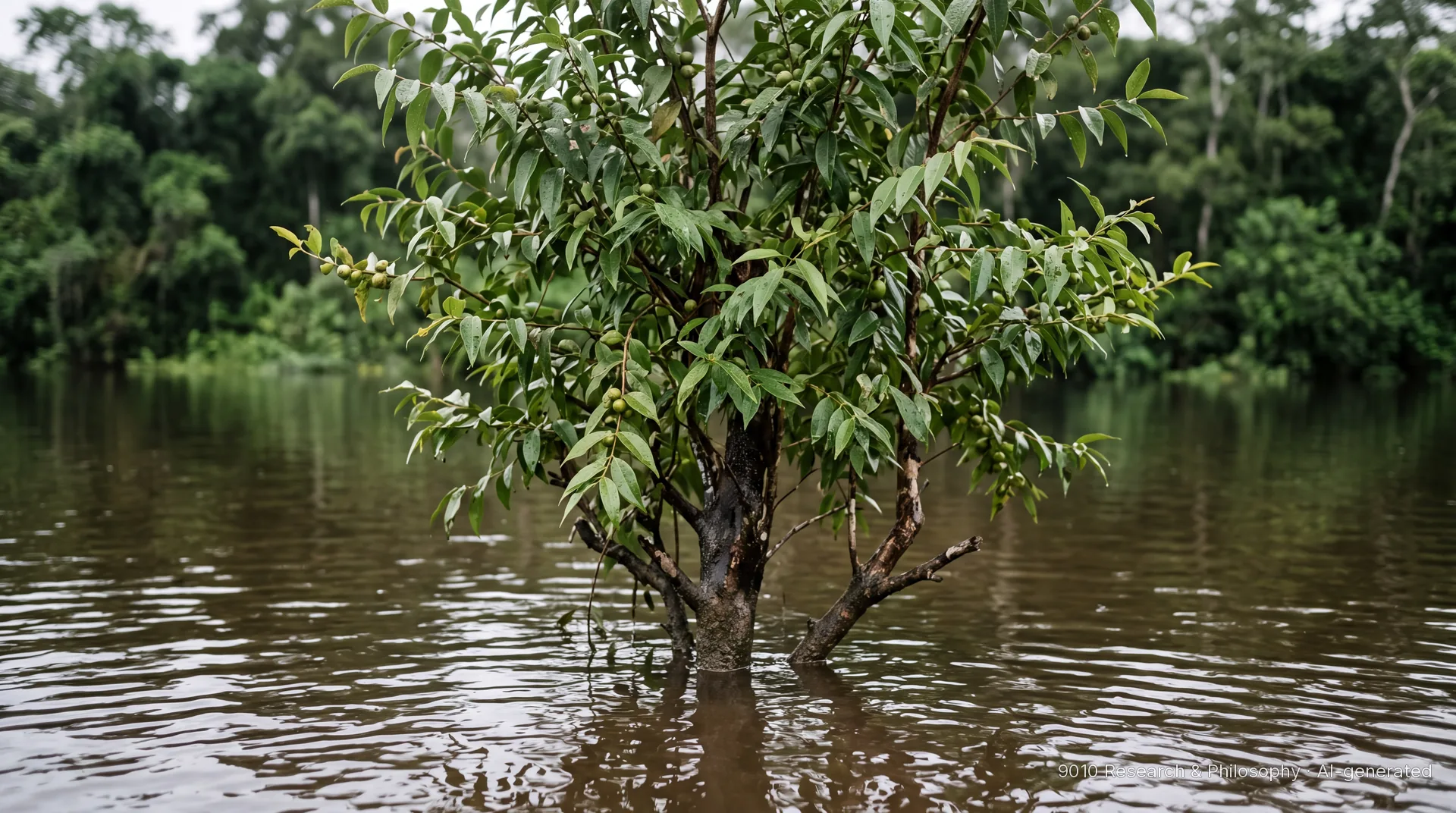
Imagine a forest, right? But not just any forest. I want you to picture one that is completely, entirely submerged. Yeah, totally underwater. Exactly. The rivers of the Peruvian Amazon have burst their banks, the water is rising fast, and we are talking about floodwaters anywhere from 5.0 to 12.1 meters deep. Which is, I mean, that's nearly 40 feet of water.
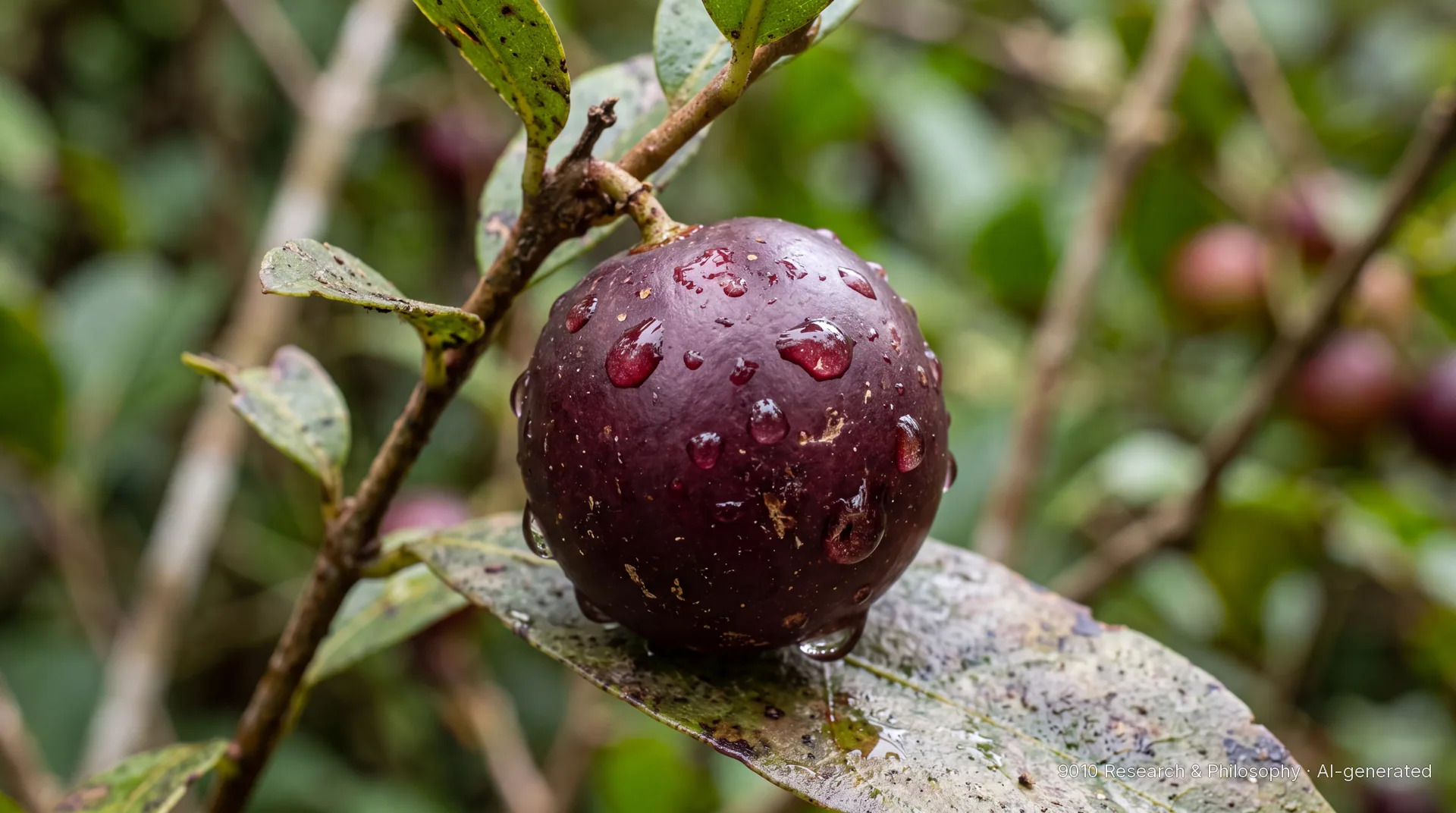
It's massive, and standing right in the middle of this crushing deluge, just holding its breath for months on end, is a shrub. And it's carrying this small, cherry-sized fruit, a fruit that just happens to be the undisputed vitamin C gold standard of the world. It really is. But here's the catch. You know, the physical science of how to actually harvest and process this superfood is just a complete mess of contradictions.
It's so messy that frontier researchers are starting to bypass the physical plant entirely. So welcome to 9010 Research & Philosophy, and thank you for joining us on this deep dive. Today, our mission is unpacking the sheer botanical puzzle that is Camu-Camu. It is a phenomenal puzzle.
I mean, we are looking at a plant that doesn't just survive an extreme, totally hostile environment. It somehow uses that exact environment to produce a biochemical profile that completely rewrites what we thought we knew about vitamin C in nature. Okay, let's unpack this because we have a very specific map for you today. We are dividing this deep dive into two very distinct territories.
Part one is going to be strictly hard science. We are going to look at the measurable facts, the exact numbers, the verified botany, and the rigorous and honestly, sometimes incredibly frustrating, laboratory findings. Exactly, and because the hard science is so full of gaps and, well, contradictions, we will then make a clear, explicitly announced transition into part two. Right.
We will leave the measurable science behind and enter frontier science to explore the hypotheses and theoretical frameworks of 9010 Research & Philosophy. But, and this is key, we will keep those two worlds strictly separated. Absolutely strictly separated. So let's start in the water with part one, the hard science.
We're in the Peruvian Amazon. The shrub is scientifically known as Myrciaria dubia, and the water is up to 12.1 meters deep, meaning the entire plant is totally submerged. Yeah, completely under. How on earth does a terrestrial plant survive that?
It's like a free diver who mysteriously thrives under extreme pressure for half the year. What is the actual physiological mechanism keeping it alive? Well, what's fascinating here is we literally have no idea. Science is completely blank on this.
Wait, really? With all the research out there, nobody has checked how it breathes. Not a single primary study exists on the physiology of its flood tolerance. I mean, we have hypotheses, of course, but we don't know if it develops special adventitious roots, which are essentially these emergency roots that sprout above the soil line to pull oxygen from the water.
We don't know if it shifts into an anoxic metabolism, basically changing its internal chemistry to survive without oxygen, sort of similar to how yeast ferments or, you know, if it uses aerenchyma tissue. Aerenchyma tissue. Yeah, so aerenchyma tissue is essentially this spongy, highly porous tissue that acts like a built-in snorkel system. It allows the plant to store and channel oxygen straight down into its roots.
It's a brilliant evolutionary adaptation, but we have zero proof the Camu-Camu actually uses it. Nobody actually knows how it survives being underwater for months. That is an absolute blank spot on the map. But clearly, whatever it's doing down there in the dark, it works perfectly because it produces this incredible fruit.
So let's bring it up to the surface. If the environment is this intense, what does the fruit actually taste like? Like, if I pull a fresh camu-camu right off the bush and take a bite, what am I experiencing? Oh, you would immediately spit it out.
It is practically inedible raw. That bad. It is intensely, overwhelmingly sour. And thanks to rigorous biochemistry, we know exactly why.
When researchers took exact measurements from a freeze-dried powder of the fruit, they found that it contained 6,307 milligrams of L-ascorbic acid. That's the vitamin C per 100 grams. But that massive dose of vitamin C is actually overpowered by a completely different acid. It contains 7,203 milligrams of malic acid per 100 grams.
Oh, wow. Malic acid. That's the compound that gives green apples that really sharp mouth-puckering tartness, right? Precisely. Now imagine that tartness multiplied exponentially. The malic acid actually outnumbers the vitamin C.
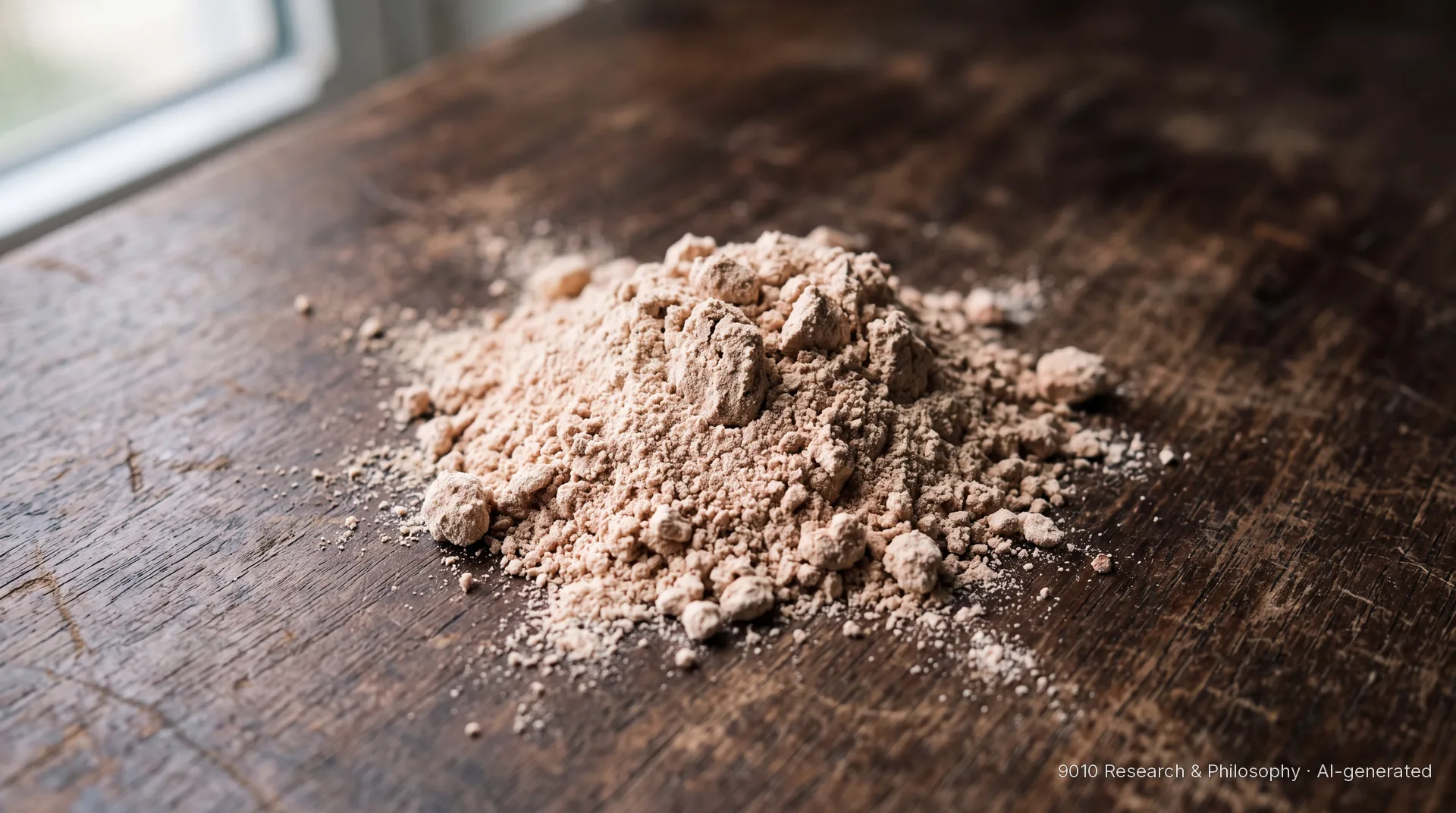
That sounds intense. It is. That is why whenever you hear about people consuming camu-camu locally in Peru, it is almost always diluted heavily into a juice, sweetened with a ton of sugar, or processed into a dry powder. You're not just popping these raw like blueberries. Right. But the vitamin C, you do get from it.
That's 6,307 milligrams. That's the real deal, right? Completely. The plant manufactures this L-ascorbic acid entirely on its own through a specific genetic blueprint. There is no provitamin here, meaning your body doesn't have to do any metabolic heavy lifting to convert it into a usable form. It's just ready to go.
Exactly. It is direct, raw, bioavailable L-ascorbic acid. Okay, so we know it's packed with vitamin C. But you hear so many wild claims in the supplement world. You know, every week there's a new superfood or the ultimate source of something. How does Camu-Camu actually stack up against the established heavyweights?
Let's talk about the measurement maze, because trying to compare nutritional labels between different fruits seems like a total nightmare. It is the definition of a measurement maze. So often in the scientific literature, researchers are comparing apples to oranges, or, you know, more accurately. They are comparing the fresh, water-filled weight of one fruit against the dehydrated, dry weight of another. Which just totally breaks the scale.
It drastically skews the numbers. But we do have one perfectly clean, direct laboratory comparison where both fruits were measured on the exact same dry matter pulp basis. Okay, a true apples to apples comparison. The gold standard. Camu-Camu versus the famous acerola cherry, which is, you know, usually considered the king of vitamin C. What are the exact numbers there? Well, on a perfectly equal dry matter pulp basis, the acerola cherry comes in at an impressive 2,063.8 milligrams per 100 grams. Yeah, not bad at all. But the Camu-Camu, it sits far, far above it at 6,754.7 milligrams per 100 grams.
That is more than three times the amount. 6,754.7 compared to just 2,063.8. That isn't just a slight competitive edge. I mean, that's existing in a completely different nutritional stratosphere. It really is. And if we look even closer at the physical anatomy of the Camu-Camu itself, the distribution of that vitamin C isn't even uniform. What do you mean?
The outer skin is significantly richer than the inner flesh. We're looking at a mean of 2,047 milligrams strictly in the skin versus 1,445 milligrams in the pulp per 100 grams. Which makes total sense from an evolutionary standpoint, right? The skin is the plant's armor against that harsh Amazonian sun in the floodwaters. Exactly.
But here's what I don't understand. If we have the tools to know exactly how much vitamin C is in the skin, in the pulp, in the dry powder, then harvesting this thing should be pretty straightforward. You just pick it when it's at its peak. But looking at your notes, the hard science can't even agree on when to pick it.
It seems like a complete botanical controversy. Oh, it really is a controversy. The scientific literature is entirely split down the middle. On one side, you have researchers like Pinto et al., who measured the exact same fruit across its different ripening stages on the bush.
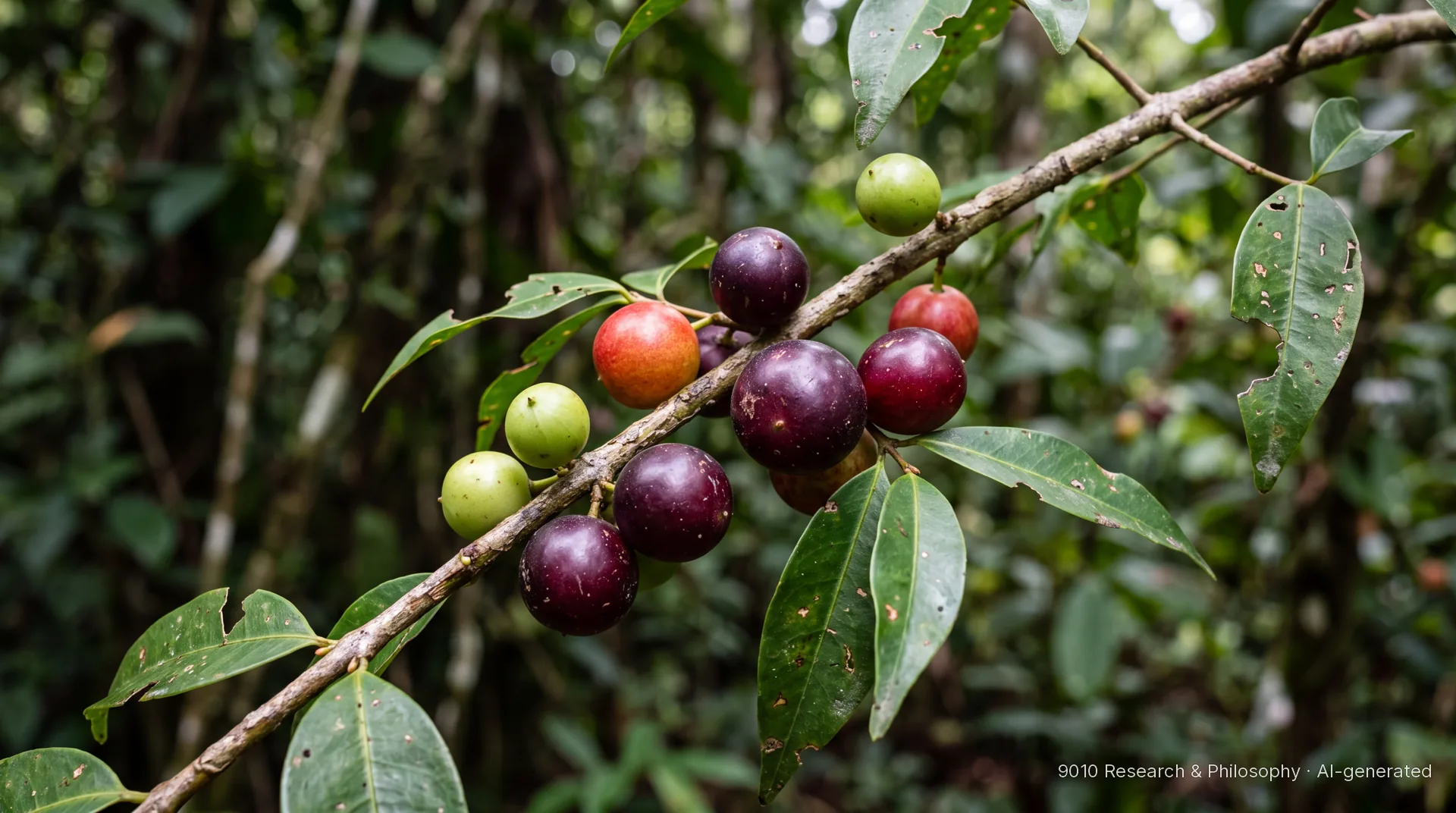
They found that in the green, completely unripe stage, it had 759 milligrams. But as it ripened to a full, deep purple stage, it rose significantly to 1,071 milligrams. Okay, so case closed, right? You just wait until it turns purple to get the maximum yield.
You would assume so based on Pinto's work, but other studies find the exact opposite. They found the absolute highest levels in the green, unripe fruit. Wait, really? Yeah, their explanation is that as the fruit ripens and softens, the internal chemistry changes, and the higher levels of natural acids actually favor the rapid degradation of the vitamin C.
So the scientists are fundamentally arguing over whether the vitamin C goes up or down while it's still attached to the bush. That is wild. But what happens once the farmer actually picks it? Does the chemistry at least lock in then?
Not at all. It becomes even more chaotic. The chemical matrix of the fruit keeps shifting day by day while it is just sitting in the harvest basket on a boat. And again, the hard data conflicts wildly.
Let me guess. Pinto says one thing. Yep. After harvest, Pinto's studies saw the vitamin C content mysteriously rise, hitting 1,568 milligrams by the sixth day sitting in storage.
It goes up while sitting in the basket. According to that study, yes. But another researcher, Grigio, measured a severe decline in post-harvest fruit, dropping from 6,602 down to 5,511 milligrams per 100 milliliters between days five and eight. I cannot imagine being a commercial farmer trying to deal with this.
You pull this extremely sensitive fruit off a bush in the middle of a flooded river basin, you put it in a basket, and it is literally changing its chemical identity every single day. Right. And the smartest scientists in the world can't even definitively tell you if your crop is gaining or losing nutritional value while you transport it. Which brings us to the ultimate trade-off.
This is the harsh, unavoidable reality of harvesting Camu-Camu in the physical world. Let's say you follow the data that says fully purple fruit has the maximum vitamin C content. If you pick it fully purple, you get a severely shortened post-harvest life. It softens, ferments, and spoils incredibly fast.
If you want the highest post-harvest quality and a shelf life long enough to actually survive the trip out of the Amazon, you have to pick it earlier when it still has a firm red-green coloring. So you literally have to choose. You can harvest for maximum potential vitamin C content, knowing half your crop might rot on the boat, or you harvest for shelf life so it actually survives the trip to the processing facility, but you're sacrificing potential potency. You cannot have both.
Exactly. It's a fundamental physical conflict that cannot be resolved. It just has to be decided by the harvester. Well, let's talk about that processing facility because here's where it gets really interesting.
In my mind, and I think for almost everyone listening, the golden rule of nutrition is that fresh is always better. Sure, that's the standard advice. Right. If you want the absolute best vitamin C, you go to the Amazon, pluck a red-green camu-camu right off the bush, and suffer through the sour taste to eat it raw.
Processing, drying, pulverizing, that is always a net loss of nutrients. That is the widespread intuitive assumption. But a surprising laboratory digestion model completely twists that logic. How so?
Researchers created a highly controlled model using artificial human gastric and intestinal fluids, simulating our exact stomach acids and enzymes to see how much ascorbic acid was actually released from the fruit and made accessible for absorption. Okay, making a fake stomach in a lab. Exactly. When they tested the fresh, raw fruit, only 30% of the ascorbic acid was released. Wait a second. That defies everything we are taught about whole food nutrition.
Only 30%. Where does the other 70% go? It stays permanently bound up in the tough cellular matrix of the fruit, acting almost like a microscopic prison, and it just passes right through your digestive tract, completely unused. But here is the mechanism that changes everything. When they ran the exact same artificial digestion model on the processed, dried powders, 54 to 65% of the ascorbic acid was released.
How is that physically possible? How can pulverizing and drying a fruit somehow make it more nutritious than eating it raw off the branch? Because the drying and milling process physically shatters that tough cellular wall. It acts as a mechanical pre-digestion phase.
Oh, I see. Yeah, by breaking down the plant's architecture before it ever reaches your stomach, it liberates the nutrients, making them highly accessible to the artificial gastric fluids. It really tells heavily against the assumption that all processing is inherently a loss. But that certainly doesn't mean processing is without its dangers.
Because once you liberate that vitamin C and turn it into a powder, it seems like you have to baby it. Heat is basically the enemy of ascorbic acid, right? Why is that? Heat is the absolute main enemy because ascorbic acid is an incredibly highly volatile molecule. When it is exposed to heat, the literal molecular bonds of the vitamin begin to vibrate and break apart, causing rapid degradation.
Yeah, when researchers stored spray-dried camu-camu powder, the exact losses were staggering. After 30 days stored at 30 degrees Celsius, it lost 39.5% of its vitamin C. Just to put that in perspective for you, 30 degrees Celsius is about 86 degrees Fahrenheit. That's not a hot oven. That's just a warm summer day.
Or an average shipping container or a warehouse without air conditioning, and you lose almost 40% of your vital nutrients in a single month. Exactly. And the curve is steep. If that warehouse gets just 10 degrees warmer, hitting 40 degrees Celsius, you lose a massive 57.1% in that exact same 30-day window. That's crazy.
Just 10 degrees of heat physically breaks down another fifth of whatever vitamin C you had left. And it's not just the temperature that destroys the value, right? It's the actual manufacturing process. Yeah.
I was looking at the data on how they physically make these powders. If you use a spray drying method, you can't just spray the pure camu-camu juice into a hot chamber. No, you can't. The natural sugars turn it into a sticky, unusable molasses on the walls of the machine.
Yeah. You have to add a carrier substance, usually something like maltodextrin, so it binds and forms a dry powder. And that carrier just dilutes the final product wildly, doesn't it? It does.
Mathematically, it just has to. A study compared two different carrier powders used on the exact same camu-camu juice at the exact same temperature. One carrier resulted in a finished powder with 15,363 milligrams of vitamin C per 100 grams. The other carrier resulted in just 11,258 milligrams per 100 grams.
That is a massive difference of over 4,000 milligrams, entirely dictated by which inert carrier powder the manufacturer chose to mix it with. The vitamin C wasn't even destroyed by heat in that case. It was just physically crowded out by the filler. Which is why understanding the exact processing chain, the temperature, the humidity, the carrier agents, is so critical in the hard sciences.
The environment shapes the molecule. So we've spent the first half of this deep dive talking about exactly what hard science knows. The exact milligrams, the molecular bonds, the temperatures. But I think we need a moment of radical honesty here about what science does not know.
Because if you read the marketing claims online for camu-camu powders, you would think we have this fruit perfectly mapped out in human biology. If we connect this back to the bigger picture of evidence-based rigorous science, the gaps are glaring. Let's be completely blunt with you listening. There are zero human bioavailability studies measuring a vitamin C endpoint for camu-camu.
Wait, zero. Out of all the studies out there, we have no clinical data showing how much of this specific vitamin C actually hits a human bloodstream. Not one. There are a grand total of three studies that compare the fruit powder to pure synthetic ascorbic acid, but incredibly none of them measured actual blood ascorbate levels, cellular uptake kinetics, or urinary excretion in humans.
We simply do not have the hard data on what happens inside a human body. And what about basic safety? I mean, we're taking a fruit grown in Amazonian floodwaters, sometimes near areas facing heavy deforestation and illegal gold mining, and we were concentrating it down into a potent powder. Do we actually know exactly how pure it is?
Again, the data is entirely missing. There is no purity data measuring heavy metals like lead, cadmium, or mercury, specifically for this fruit powder from the region. We have no pesticide residue measurements. Anyone assuming a commercial batch is perfectly pure is making a massive leap of faith, not a scientific conclusion based on verified data.
Okay, we have reached a critical juncture in this deep dive because the hard science is so full of unexplainable gaps. From the mystery of how the plant survives underwater to the agonizing contradictions of when to harvest it, researchers like Oliver Schacke have proposed a radical pivot. Yes, they have. They aren't looking for answers under a microscope anymore.
They're looking at entirely different theoretical frameworks. So, I am making an explicit, clearly announced transition here. We are now officially leaving the realm of measurable hard science. We are crossing the line into frontier science to explore the hypotheses of 9010 Research & Philosophy.
I want to be absolutely clear. Everything we discuss from this point forward is presented as a research model and a hypothesis. It is not proven laboratory fact. That is a crucial distinction.
We must keep these two worlds strictly separated. The physical measurable findings we just discussed do not validate the theoretical model we are about to explore. And this new model does not alter the measurable physical facts. Exactly.
So with that firmly established for everyone listening, let's look at this frontier science. Let's talk about the Two-World Model developed by Oliver Schacke. In Oliver Schacke's Two-World Model, reality is understood in two distinct but parallel layers. World one is exactly what we just spent the first half of this deep dive agonizing over.
The physical stuff. Right. It is the measurable biochemistry. It is the physical mass of the fruit, the temperature degradation in the warehouse, the exact milligrams of malic acid.
It is the tangible matter. But the model hypothesizes a world two. And world two is pure information. It has no measurable physical quantities whatsoever.
So what does this all mean? To me, it's like world one is the physical hardware of a computer. The metal casing, the silicon chips, the glass screen. You can weigh it, you can measure it, you can drop it and break it.
Yeah, exactly. And world two is the software code that tells that hardware how to operate. The software code doesn't weigh anything. You can't put it on a physical scale.
But without it, the hardware doesn't know what it's supposed to be. That is an excellent, precise analogy. In this theoretical model, every physical thing in world one has a corresponding, perfect informational blueprint residing in world two. And to explain where that informational blueprint actually resides, the model utilizes the biologist Rupert Sheldrake's concept of the morphic field.
The morphic field. Yeah. How does that concept work in relation to a physical Camu-Camu plant? Under this hypothesis, the morphic field acts as a sort of universal memory bank of nature.
It is an informational space where nothing is ever lost, and it never fills up or runs out of storage. A specific Camu-Camu fruit has a signature, a complete, flawless, informational pattern of what it is at its absolute peak. That signature isn't stored in the physical cells that rot on a boat, you know. It is stored eternally in the morphic field.
Okay, so if this signature, this pure informational software code of the perfect vitamin C fruit, is out there hovering in the morphic field, how does 9010 Research & Philosophy actually interact with it? How does the frequency code VIT9010C tap into that blueprint? This brings us right back to that maddening harvest dilemma we discussed in World One. Remember how the physical science couldn't agree on the best time to pick the fruit?
Right, the unripe green fruit with high acids, the turning red-green fruit for shelf life, the fully ripe purple fruit that spoils immediately. Exactly, the ultimate trade-off where the physical chemistry keeps changing every day in the basket and the farmer is forced to compromise. Well, the hypothesis behind the frequency code VIT9010C, which literally stands for vitamin C from 9010, is designed to bypass that physical limitation entirely. Because science couldn't isolate a single peak physical moment, the researchers captured the informational signature of all three stages of ripeness.
Wow. They took the blueprint of the young fruit, the turning fruit, and the fully ripe fruit. So they didn't have to compromise. They just captured the data of the entire biological life cycle.
Yes, and they went a step further in the model. They also captured the informational signature of the finished powder, gently dried and completely without a carrier substance, avoiding that physical dilution from maltodextrin we talked about earlier. In the framework of this model, all of this information, the three vital stages of the fresh fruit and the pure undiluted dried powder, is conceptually frozen into a single unified imprint in the morphic field. So if I'm understanding the model correctly, it's like taking four different perfectly written software programs and combining them into one master code in World 2.
But how do you actually access it? I saw the term entanglement being used in the research, but that sounds dangerously close to quantum physics. Is it like tuning a radio? Where the radio tower is broadcasting the camu-camu frequency everywhere, and entanglement is just the act of tuning our physical receiver to catch that specific station?
This raises an incredibly important question, and your radio analogy is spot on. We need to firmly clarify the terminology here. To access this specific frequency code in the morphic field, the model uses the word entanglement, but I must explicitly state to you that this word is being used purely as an image, as a metaphor for their research model. It is not a claim of laboratory physics or quantum mechanics.
That is vital to understand. They aren't saying they have a physical particle accelerator locking photons together in a lab. They're using entanglement purely as a descriptive term for how their World 2 model connects a user to that specific signature in the morphic field. Precisely.
It is a theoretical mechanism strictly within frontier science to describe accessing that unified imprint of the Camu-Camu's pure information, completely independent of the physical, measurable, and highly volatile World 1. It's just wild to pull back and look at the entire picture we've painted for you today. We started deep in the flooded Amazon basin looking at a mysterious shrub holding its breath under 12 meters of dark flood water. Yeah.
To the exact, rigorous, often painfully contradictory, measurable biochemistry of its vitamin C. We saw how something as simple as a warm warehouse or a maltodextrin carrier can absolutely destroy its potency. And then we stepped entirely out of the physical realm into the frontier hypotheses of morphic fields, pure information, and the idea of capturing a plant as a perfect, unchanging blueprint. It is a remarkable journey from the most extreme physical environments on Earth to the most abstract theoretical models we can conceive.
And if we connect this to the bigger picture, it really forces us to ask profound questions about how we view sustenance, biology, and memory itself. Yeah, it really does. And on that note, we want to leave you, the listener, with a final provocative thought to mull over on your own as you go about your day. Consider this: if a plant's peak nutritional signature, its perfect biological software code, is forever stored as pure information in a morphic field long after the physical fruit has degraded, well, it begs a massive question: what other lost botanical cures, or entirely extinct plant species, are still out there in World 2, endlessly broadcasting their blueprints, just waiting for us to tune in to the right frequency?
That is definitely something to chew on. Thank you so much for joining us on this deep dive into 9010 Research & Philosophy. We hope you're walking away with a few "aha" moments, a deeper respect for the absolute mysteries of the Amazon, and maybe a completely new way of looking at the invisible world around you. Until next time, stay curious.